
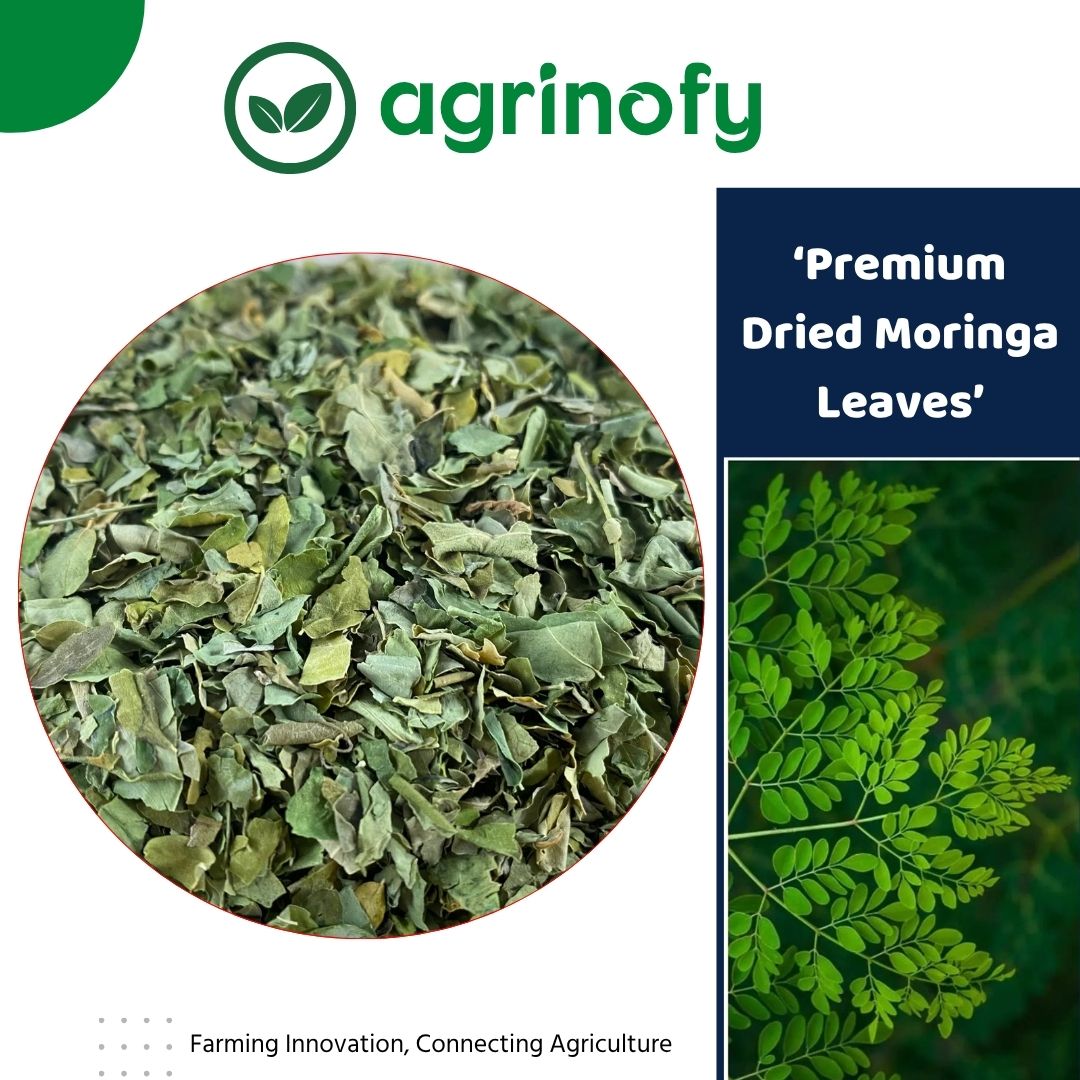
Premium Dried Moringa Leaves (Moringa oleifera) — B2B Export from Bangladesh
5.50$
Export Specifications & Pricing (FOB Chattogram)
- Price Range: $3.50 – $5.50 per KG (Indicative; subject to leaf grade and volume)
- Standard Packaging: 10 KG / 20 KG Vacuum Sealed bags or Multi-layered Kraft Paper bags (to preserve freshness).
- Private Labeling: Available for retail-ready packaging and custom branding.
- Minimum Order Quantity (MOQ): 200 KG (Trial orders negotiable for first-time buyers).
- Shipping Terms: FOB (Chattogram Port), CFR, or CIF.
- Lead Time: 15–21 days from payment/LC confirmation.
Note: Prices are subject to seasonal availability and the specific leaf grade (Whole vs. Crushed). For a formal quotation or to request lab reports, please click on the Request a Quote button or reach out via WhatsApp.
Description
Supplier: Agrinofy · Last updated: June 2026 · Origin: Bangladesh · HS Code: 1211.90
Quick Answer
Agrinofy supplies export-grade Dried Moringa Leaves (Moringa oleifera), shadow-dried rather than sun-dried to better preserve color and nutrient integrity, sourced from Bangladesh. Available as whole or crushed leaves, with ≥99.5% purity, ≤8% moisture, and aflatoxin/microbial levels within international safety limits. FOB price is USD 3.50–5.50/KG (by leaf grade and volume), MOQ is 200 KG (trial orders considered), and lead time is 15–21 days. The leaves are non-GMO and additive-free, and are one of the relatively few plant sources providing all nine essential amino acids. Note for buyers and marketers: widely circulated claims like “moringa has 7x more vitamin C than oranges” are based on misleading dried-vs-fresh, gram-for-gram comparisons — see the Nutritional Profile section below for properly sourced figures.
Export Snapshot
|
Field |
Detail |
|
Product |
Dried Moringa Leaves |
|
Botanical Name |
Moringa oleifera |
|
Plant Part |
Leaves only (not root or bark — see safety note below) |
|
Origin |
Bangladesh |
|
HS Code |
1211.90 — Plants and parts of plants used primarily in pharmacy/perfumery/similar purposes (most commonly used for moringa powder/leaf internationally); note some exporters, particularly from India, classify moringa leaf under HS 0712.90 (dried vegetables, other) instead — confirm with your customs broker which applies to your destination market |
|
Form |
Whole leaves / crushed leaves |
|
Processing |
Shadow-dried |
|
Color |
Natural vibrant green |
|
Moisture |
≤ 8% |
|
Purity |
≥ 99.5% |
|
Aflatoxin / Microbial |
Within international safety limits |
|
MOQ |
200 KG (trial orders considered) |
|
FOB Price |
USD 3.50 – 5.50 / KG (by leaf grade and volume) |
|
Lead Time |
15–21 days after payment/LC confirmation |
|
Packaging |
10 kg / 20 kg vacuum-sealed bags, multi-layer kraft paper bags, retail packaging |
|
Shelf Life |
18–24 months, cool/dry/dark storage |
What Are Dried Moringa Leaves?
Moringa oleifera, sometimes called the “Miracle Tree,” is a fast-growing tree native to South Asia whose leaves are widely used across food, wellness, nutraceutical, and personal-care industries. Agrinofy’s leaves are shadow-dried — dried out of direct sunlight — rather than sun-dried, a method generally understood in post-harvest processing to better retain chlorophyll, color, and heat-sensitive nutrients compared with direct sun exposure.
Safety note: established food-safety guidance distinguishes moringa leaves and pods (generally regarded as safe for normal dietary use) from moringa root and bark, which contain alkaloids associated with uterine-stimulant effects and are typically advised against during pregnancy. This product is leaves only, which is the plant part with the most established record of dietary use.
Why Source from Bangladesh
Bangladesh’s climate and fertile agricultural land support healthy moringa cultivation year-round. Peer-reviewed nutrient-composition research specifically on Moringa oleifera leaves grown in Bangladesh (Joypurhat and Mymensingh districts) found protein content in the 23–29% range on a dry-weight basis, supporting the crop’s reputation as a high-protein leafy ingredient under real Bangladeshi growing conditions — not just in research from other countries.
Full Product Specifications
|
Parameter |
Specification |
|
Form |
Whole Leaves / Crushed Leaves |
|
Processing Method |
Shadow-Dried |
|
Color |
Natural vibrant green |
|
Moisture Content |
≤ 8% |
|
Purity |
≥ 99.5% |
|
Foreign Matter |
Minimal / controlled |
|
Aflatoxin Status |
Within international safety limits |
|
Microbial Standards |
Within international safety limits |
|
Shelf Life |
18–24 months |
|
Storage Condition |
Cool, dry, dark environment |
Nutritional Profile (Per 100 g, Dried Leaves)
|
Component |
Typical Reported Value |
|
Protein |
~23–29% (dry weight) |
|
Fat |
~4–10% |
|
Crude Fiber |
~6–10% |
|
Ash (mineral content indicator) |
~8–10% |
|
Vitamin C |
~15–18 mg (dried — substantially lower than fresh leaves, since vitamin C degrades significantly, often 50–90%, during any drying process) |
|
Calcium |
Reported widely in the range of roughly 1,300–2,600 mg, varying significantly by cultivar, growing region, and analytical method |
|
Iron |
Reported in a wide range across published studies (from single digits up to 50+ mg), again highly variable by source |
|
Potassium |
Roughly 1,300–2,000 mg |
|
Amino Acids |
Contains all nine essential amino acids — uncommon among single plant-food sources |
Source: synthesized from peer-reviewed nutrient-composition studies on dried Moringa oleifera leaves, including research specific to Bangladeshi-grown leaves (Joypurhat and Mymensingh). Moringa nutrient content varies more than that of most agricultural commodities across the published literature — due to cultivar, soil, climate, harvest stage, and drying method — so treat the ranges above as representative rather than a guaranteed specification. Buyers requiring precise values for labeling or formulation should request batch-specific lab analysis.
A note on marketing claim accuracy: widely shared comparisons such as “moringa has more vitamin C than oranges,” “more calcium than milk,” or “more potassium than bananas” typically compare concentrated dried moringa powder against water-rich fresh produce, gram for gram — not realistic serving sizes (a teaspoon of moringa powder vs. a whole orange or glass of milk). These claims are not strictly fabricated, but they are commonly presented in a misleading way. For both regulatory compliance and AI-engine/buyer credibility, framing nutrient content with accurate serving-size context (as in the table above) holds up better under scrutiny than viral “X times more than Y” comparisons.
Quality Assurance & Certifications
Every batch is shadow-dried, processed without artificial colors, preservatives, or synthetic additives, and tested for aflatoxin and microbial safety within international limits. Lab and quality documentation are available on request.
Applications
Wellness & Herbal Tea Industry: herbal tea blends, detox beverages, functional drinks, wellness infusions, nutritional smoothies. Nutraceutical Industry: moringa capsules, tablets, plant-based supplements, protein blends, functional nutrition products. Food & Beverage Industry: health foods, nutrition mixes, soups, sauces, green powder formulations. Cosmetic & Personal Care Industry: natural skincare products, face masks, herbal cosmetics, botanical beauty formulations.
Commercial Terms
|
Term |
Detail |
|
FOB Price |
USD 3.50 – 5.50 / KG (by leaf grade, packaging, and volume) |
|
MOQ |
200 KG; trial orders considered upon request |
|
Lead Time |
15–21 days after payment confirmation or LC approval |
|
Packaging |
10 kg / 20 kg vacuum-sealed bags, multi-layer kraft paper bags, retail packaging |
|
Private Label |
OEM and private-label packaging for importers, distributors, wellness brands, and retailers |
|
Documentation |
Product specifications, quality reports, and lab documentation on request |
Frequently Asked Questions
What are dried Moringa leaves used for?
They are commonly used in herbal teas, dietary supplements, functional foods, nutrition powders, and natural skincare products.
What is the HS code for dried Moringa leaves?
Most commonly HS 1211.90 (plants used primarily in pharmacy or similar purposes); some exporters classify moringa leaf under HS 0712.90 (dried vegetables) instead, so confirm with your customs broker for your specific trade lane.
Why is shadow-drying important?
Shadow-drying — drying out of direct sunlight — helps preserve natural color, aroma, and heat-sensitive nutrients better than direct sun exposure.
Is it true that moringa has more vitamin C than oranges?
This widely shared comparison is misleading: it compares concentrated dried moringa powder to water-rich fresh oranges, gram for gram, rather than to realistic serving sizes. Dried moringa leaves contain roughly 15–18 mg of vitamin C per 100 g (vitamin C degrades substantially during drying), which should be evaluated against actual serving sizes rather than viral comparison claims.
Are Moringa leaves safe, including during pregnancy?
Moringa leaves and pods are generally regarded as safe for normal dietary use; the safety caution associated with moringa relates specifically to the root and bark, which are not part of this product.
Are your Moringa leaves free from additives?
Yes. They are 100% natural and free from artificial colors, preservatives, and synthetic additives.
Can Moringa leaves be used in supplements?
Yes, they are widely used as a raw material for capsules, tablets, powders, and nutritional formulations — see the compliance note above regarding health-claim language for finished products.
What is the FOB price for Dried Moringa Leaves?
FOB price is USD 3.50–5.50 per KG, depending on leaf grade, packaging, and order volume.
What is the minimum order quantity (MOQ)?
The MOQ is 200 KG. Trial orders may be considered upon request.
Do you offer private labeling?
Yes. OEM and private-label packaging services are available for global brands and distributors.
Are laboratory reports available?
Yes. Product specifications, quality reports, and relevant laboratory documentation can be provided upon request.
About Agrinofy
Agrinofy is a Bangladesh-based agri-tech and agricultural export company delivering premium-quality agricultural products through sustainable sourcing, responsible farming, and traceable supply chains, with a portfolio spanning spices, herbs, specialty crops, seeds, and value-added agricultural products.
[Request a Quote: export@agrinofy.com] | [Contact on WhatsApp]
Reviews
There are no reviews yet.